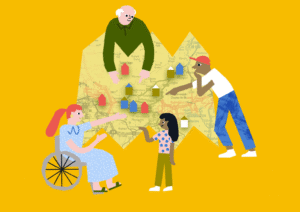
Source: Research on exploring the role of (co)design by Penny Hagen
Designing with, not for, that’s the shift we set out to make in this phase of the project.
After weeks of trust-building in Bhumiya Basti, Sodala, and Shastri Nagar, it was time to move forward: from conversations to co-creation. Using paper models, scaled maps, sketching tools, and shared stories, we began a series of co-design workshops with adolescents to imagine what safer, more vibrant public spaces could look like in their neighbourhoods.
This phase of the project was a reminder that adolescents aren’t just users of space; they’re creative thinkers and community anchors when given the tools and trust.
Framing the Process: Why Co-Design?
Traditional planning often assumes what young people need; a park, a bench, a basketball hoop. But these assumptions frequently miss the real barriers: constant adult monitoring that discourages free expression, male-dominated spaces that make girls feel unwelcome, unsafe access routes, and the absence of programs that genuinely resonate with adolescents.
Tools and Methods We Used
We knew fancy tech wasn’t the answer. Instead, we used simple, tactile, and accessible tools:
- Scaled maps of the neighbourhood printed in black and white
- Colour stickers and threads to mark “safe” vs “unsafe” zones and movement paths
- Model-making with paper, clay, and discarded materials to visualise small-scale park interventions
- Post-it walls for dream statements: “In my park, I want…” or “The best space in my area is…”
- Peer-led brainstorming groups, where adolescents formed teams and took turns presenting ideas
The process was designed to be low-tech, inclusive, and joyful, inviting creative expression across literacy levels and gender identities.
What Emerged from These Sessions
Across all three neighbourhoods, certain themes appeared again and again:
- Visibility = Safety
Girls emphasised the importance of open sightlines, minimal walls, and adequate lighting. One group designed a “mirror corner” so that users could see who was approaching from behind. - Programs Over Infrastructure
Adolescents asked for evening events, sports tournaments, dance corners-not just benches or swings. A park that’s used is a park that feels safe. - Territory Matters
Boys and girls often used different routes or entered parks from different points. In Jawahar Nagar, girls proposed a “quiet zone” at the back of the park, while boys suggested a central play court. - Colour and Identity
Many wanted murals, bright colours, and community artwork that reflected local stories and people. “We want this to look like ours,” one girl said.
What I’m Learning About Youth Co-Design
These sessions have offered more than just design ideas. They’ve taught me valuable lessons about how young people engage, express, and imagine when given the right environment. Here are a few takeaways that continue to shape my understanding:
- It’s not just about collecting ideas. It’s about building the capacity of young people to become spatial thinkers. Several participants asked if they could keep the base maps to continue working on them at home.
- Language matters. When I used terms like “survey” or “design,” the energy dropped. But when I said, “Let’s draw a story,” or “Build your dream corner,” the energy came alive.
- Inclusion requires intention. We made sure to hold sessions at varied times (afternoon for school-goers, evening for working adolescents), and to explicitly invite girls, non-binary youth, and those who’d been silent during earlier visits.
What’s Next
The ideas shared by adolescents would now be translated into technical drawings, with the aim of developing them into real-world interventions using a tactical urbanism approach. These on-ground prototypes would serve as living demonstrations, showing both the community and local authorities what’s possible when young voices are included in shaping city spaces.
What stays with me is the energy, ownership, and creative chaos of the workshops. They’re a powerful reminder that meaningful design doesn’t begin on a blank screen, it begins on the ground, with people, crayons, and cardboard.