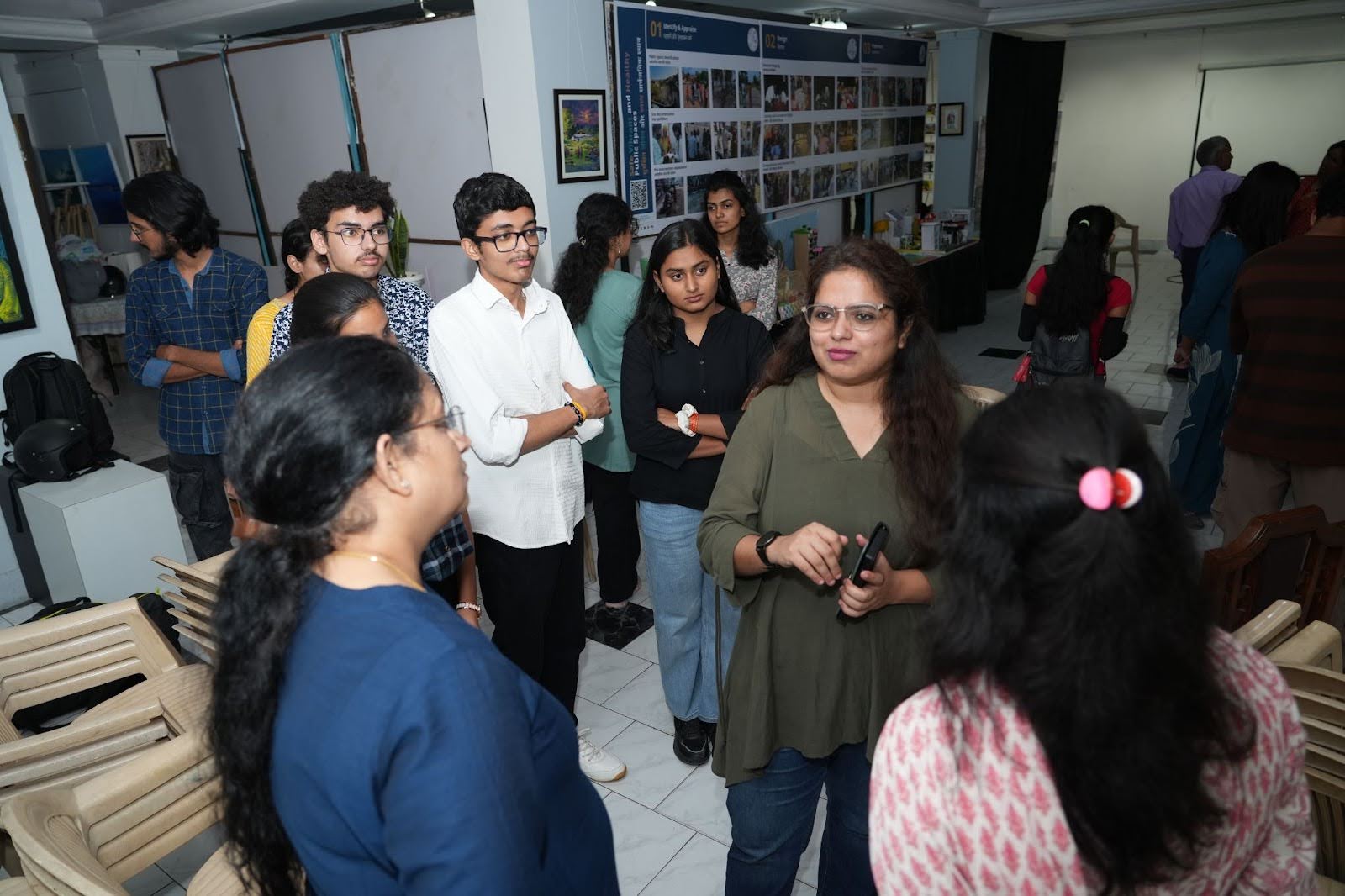
Showcasing SVHPS project to the community, government stakeholders and urban experts in Yuvascape held in October 2025
Looking Back to Look Ahead
When I began this fellowship, I thought my task was to study spaces. What I did not realise then was that I would be studying how people relate to them. Over the past year, Jaipur has been both my workplace and my teacher. It taught me that cities are not defined only by their built forms or infrastructure, but by the stories and relationships that fill their spaces.
Working on the Safe, Vibrant, and Healthy Public Spaces project helped me see Jaipur through new eyes. I began to understand how public spaces often mirror our social hierarchies, how age and gender shape who feels comfortable in them, and how safety and belonging are not guaranteed for everyone. But most importantly, I learnt that when we create opportunities for people to speak and shape their environments, we start to see the city differently.
What the Project Revealed About Cities
Early on, we met adolescents who described their city in ways that most planners never hear. They spoke about where they felt welcome, where they did not, and what it meant to find small corners of comfort in a city that often overlooked them. Their words reminded me that public space is not neutral. It can empower, or it can exclude.
Listening to these young people showed me that designing for inclusion begins with acknowledging absence. It begins with recognising whose needs have not been met, whose voices have been missing. Once we did that, the city started to open up in new ways. Every park, lane, and playground became a site of possibility, not just a site of deficit.
Cities, I realised, are shaped as much by people’s confidence to use them as by the infrastructure that defines them. A small bench in the right place can mean safety. A well-lit corner can mean freedom. When we design for comfort, care, and visibility, we design for dignity.
What the Process Revealed About Design
Before this fellowship, I often thought of design as a sequence of steps that led to a built outcome. This project reminded me that design is also a process of learning. It is about asking questions, holding conversations, and staying open to change.
Through co-design sessions, I saw how drawings, models, and maps could become tools of dialogue. The adolescents were not passive participants. They questioned, debated, and translated their daily experiences into tangible ideas. The act of making together blurred the line between professional expertise and lived experience.
Design, I learnt, is not only about creating forms or layouts. It is about enabling agency. When people contribute to shaping their environment, the design gains a life that no single author could give it.
What the Experience Revealed About Practice and Self
This fellowship changed how I understand my role as an urban designer. It taught me that meaningful design work is rarely linear or certain. It is relational. It depends on trust, patience, and empathy as much as on skill.
There were moments of doubt, moments when ideas felt stuck, and moments when the pace of institutional processes felt too slow. Yet, those moments were part of the learning too. They revealed that change in cities is not just about technical solutions; it is about persistence and the slow building of shared understanding.
Working alongside WRI India, U-CAN, and community partners showed me how design can act as a bridge between disciplines and people. I began to see collaboration not as a compromise, but as a strength. Every conversation added something new, and every disagreement pushed the work to become more grounded.
Personally, this journey deepened my belief that design should not only respond to cities but also listen to them. I found myself listening more carefully — to voices, to silences, and even to the textures of everyday life that often go unnoticed.
What Lies Ahead
The ideas and learnings from the SVHPS project are not confined to one city. They represent a way of working that values dialogue over instruction, participation over prescription, and empathy over efficiency. Whether in Jaipur or elsewhere, this approach can shape a more inclusive way of imagining urban futures.
Adolescent-centred design offers an important lesson for all of us: those who use public spaces every day often know best what they need. Our job is not only to design for them, but to design with them.
As I carry these lessons forward, I am reminded that cities are generous teachers if we are willing to listen. And in Jaipur, I learnt to listen — not just to the sound of its traffic or the rhythm of its streets, but to the quiet voices that too often go unheard.
Closing Reflection
This fellowship has been a year of learning, unlearning, and listening. It began with questions about safety and inclusion, and it ends with a deeper understanding of trust, care, and belonging. Jaipur’s adolescents have shown that change begins with imagination and grows through collaboration.
What the city taught me is simple yet profound: designing better cities begins with seeing, hearing, and believing in the people who live within them.