In my previous reflections, I explored how planning systems often exclude communities from shaping urban futures. Here, I focus on one of the most critical, and overlooked, scales of engagement: the neighbourhood.
Ten years ago, I volunteered to clean a 20-foot-high heap of mixed waste near my office in Bangalore. As I discovered later, this waste heap was at the junction of two different ward boundaries, essentially becoming a jurisdictional “no-man’s land” and therefore hosting a growing cluster of shanties alongside a rubbish heap. This left a lasting impression; it made me want to understand why our governance institutions often fail to address hyper-local issues like solid waste management, while creating ambitious urban visions inspired by Dubai’s or Singapore’s urban transformations.

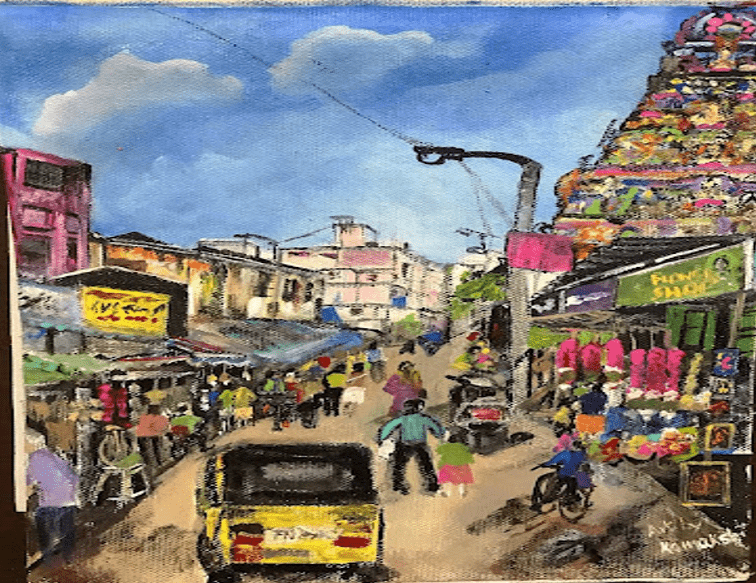
Painting showcasing the cognitive map of the neighbourhood of Mylapore defined by a historic temple and narrow shopping lanes
Despite the promise of decentralised urban governance under the 12th schedule of the Constitution (74th Constitutional Amendment) as well as heroic efforts by local citizens, planning in India remains centralised and disconnected from local realities because of a lack of institutional mechanisms and spatial frameworks to better integrate community voices into planning frameworks.
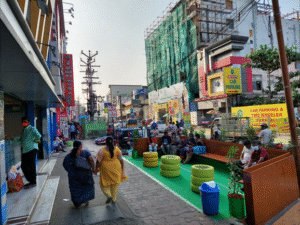
Take the example of Mylapore, a historic area in Chennai. The neighbourhood has been split into four different municipal wards, even though it functions as one community. This means that the people of Mylapore must deal with different local officials, budgets, and priorities, just to solve a shared issue. When government boundaries don’t match how communities actually live, it becomes harder to include citizens in meaningful conversations about planning.
Through my professional practice as an urban planner and designer, I have seen this disconnect play out repeatedly. Cities are shaped by masterplans; top-down documents that focus on infrastructure and land use. But they often ignore the scale that shapes daily life: the neighbourhood. Neighbourhoods are where people live, work, access services, and form identities – social scientist Doreen Massey famously described space as a “pincushion of a million stories.” [1]
For successful neighbourhood planning, effective public participation is key. While guidelines like the Urban and Regional Development Plans Formulation and Implementation (URDPFI) Guidelines, published by the Ministry of Housing and Urban Affairs of the Government of India, recognise the importance of participatory planning but lack legal enforcement. State-level laws, like the Town and Country Planning Acts, often sidestep the spirit of the 74th Amendment. In Tamil Nadu, for instance, planning power is concentrated in parastatal bodies like the Chennai Metropolitan Development Authority (CMDA) and special purpose vehicles (SPVs) like the Chennai Metro Rail Corporation, reporting directly to the State administration. Special Purpose Vehicles, or SPVs, are special government agencies set up to manage big urban projects, like metro rail systems or highways. They’re meant to help speed things up and attract private investment. But because SPVs report directly to the state government, they often bypass local councils and citizens. This makes it harder for people to ask questions, give input, or hold anyone accountable.[2]
Even countries with stronger legal frameworks face challenges. While studying in the UK, I volunteered with a community group working on Oxford’s first neighbourhood plan under the Localism Act. Although the law gave planning powers to local associations, it didn’t provide funding or training. As a result, the process relied heavily on volunteers. Without resources or long-term vision, these plans struggled to create meaningful change. India faces similar issues, only at a far larger scale. Right now, our planning paradigm centres on large infrastructure, investment, and growth. As geographer Ananya Roy has pointed out, “world-class” projects like airports or riverfronts often take priority. But these developments rarely benefit the communities next door. They’re disconnected, not walkable, and far from inclusive[3].
In Mylapore, I’ve seen the consequences of this firsthand. There’s a growing demand for community-led spaces that serve everyday needs, especially for vulnerable groups like the elderly, children, or low-income residents. While the city is investing in parks and green spaces, many areas still lack basic last-mile connectivity. People are being left out, not because of a lack of resources, but because of a mismatch between citywide plans and neighbourhood realities. As India undergoes a massive rural-to-urban shift, we need fresh thinking. Neighbourhoods must become the starting point for urban planning, not the afterthought. That means building legal protections for community participation, setting up institutions that support local planning, and ensuring real budgets to back it up.
If neighbourhoods are where identity, memory, and community come together, then that’s where our cities must begin.
[1] Doreen Massey, “On Space,” interview by Nigel Warburton, Social Science Bites, February 2013, https://www.socialsciencespace.com/2013/02/doreen-massey-on-space/. Massey describes space as “like a pincushion of a million stories.”
[2] Centre for Financial Accountability, “The curious case of Indian Smart Cities,” (accessed June 20, 2025), — argues that SPVs, operating outside directly elected bodies, suppress participatory democracy and weaken accountability because citizen inputs become non-binding or tokenistic
[3] Roy, Ananya, and Aihwa Ong, eds. 2011. Worlding Cities: Asian Experiments and the Art of Being Global. Chichester: Wiley‑Blackwell, August. ISBN 978‑1‑4051‑9276‑7.