
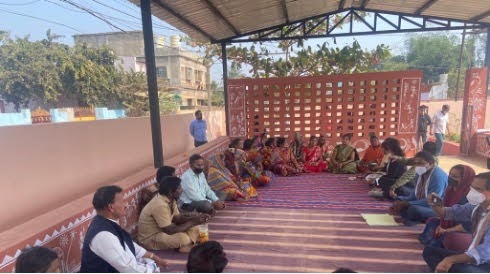
A Slum Dwellers Association Meeting
As a U-CAN fellow with Janaagraha, my study on Participatory Governance has shown that Governance is never the work of one actor alone. Laws may define what is to be done, and institutions may give form to participatory platforms, but for these forums to truly function, they need networks of collaboration to keep them alive and grounded.
This aspect of the participation ecosystem speaks to the relationships between governments, citizens, civil society organisations, elected representatives, and community-based institutions. It is through these relationships that participation becomes not just procedural but political, social, and sustained. In every case where participatory forums have worked well, they’ve been supported by a group of actors who collectively build its strength.
During my conversations with different stakeholders, from government officials to civic leaders and community organisers, I came across several functioning models of participatory governance where collaboration was the invisible force holding everything together.
In Odisha, under the Jaga Mission, the formation of Slum Dwellers’ Associations (SDAs) demonstrated what this looks like in action. The SDAs serve as recognised neighbourhood-level platforms in informal settlements, enabling residents to engage with the local government on matters of land tenure, infrastructure, and service delivery. But these associations didn’t emerge on their own. Their formation was facilitated by civil society partners working closely with ULGs, under the guidance of the Housing and Urban Development Department, Odisha. These actors together created a support structure where responsibilities were shared; mobilisation and capacity-building by NGOs, legal backing from the state, formal recognition by ULBs, and ongoing representation by community federations. This kind of interdepartmental and multi-actor collaboration allowed participatory governance to operate from the ground up, while being linked to city and state institutions.
In Bhuj, Gujarat, collaboration shaped the character of the Ward Committees. Civil society actors like Kutch Mahila Vikas Sangathan (KMVS) had long been working with SHGs and marginalised communities in the city. When the Homes in the City (HIC) programme introduced participatory platforms, it was these pre-existing relationships that helped bridge the gap between citizens and governance structures. SHG members, particularly women, became central to the formation of Ward Committees due to the years of groundwork by local NGOs like KMVS.
Another powerful example comes from Karnataka, where Ward Samiti Balaga, a citizen-led network, works in a collaborative manner with city governments to strengthen Ward Committees and institutionalise participatory governance. Comprising civil society organisations, residents, elected representatives, think tanks, apartment associations, and NGOs, the Balaga operates city-level coordination committees and organises state-level meetings to address challenges and track status of Ward Committees across Karnataka. The Balaga undertakes diverse activities to improve neighbourhood life, including awareness campaigns, working with government on participatory budgeting, mobilizing citizen participation in Ward Committee meetings and acting as a pressure group for efficient implementation of Participatory governance structures. For instance, Bengaluru’s Ward Samiti Balaga spearheaded the My City My Budget campaign (2023-24), enabling citizens to influence municipal budget allocations.
Across all these cities, a common thread emerges: participation works better when it is collaborative. This conclusion stems from both my field conversations and case study analysis, where collaboration consistently appeared as the differentiator between forums that thrive and those that merely exist on paper.
ULGs may facilitate, but they are rarely the sole drivers. Community organisations bring in trust, continuity, and local knowledge. Elected representatives help mobilise support and shape political will. NGOs provide facilitation, training, and legitimacy. And when city and state departments coordinate, vertically and horizontally, the system becomes more responsive and aligned. In contrast, where such partnerships are missing, participatory platforms often become weak or ornamental. Meetings are irregular. Agendas are unclear. Members feel disengaged. Without a network of support, the burden of running the platform falls on too few shoulders, and the structure collapses under its own weight.
Collaboration, then, is not an external bonus; it is a core condition for participatory governance to survive and scale. It embeds forums within community life and allows for co-production of solutions. It ensures that participation is not dependent on a single scheme, officer, or election cycle.
With this, the three pillars of the enabling ecosystem, legal grounding, institutionalisation, and collaboration, stand complete. Together, they provide the foundation for meaningful participation. But structure alone is not enough. The next challenge lies in ensuring that these platforms are inclusive; that they make space not just for citizens, but for all kinds of citizens, across gender, caste, class, and location.
In the next blog, I’ll explore the design aspect of these participatory avenues, because a platform is only as democratic as the voices it uplifts.


