Source: UNICEF’s Social and Community listening framework
As we move from understanding public space challenges to shaping their solutions, a critical first step is not design or planning; it’s trust-building. In underserved communities of Jaipur, especially those where adolescents face exclusion from public life, establishing trust with residents is both foundational and fragile.
In recent times, my work centered around field visits, informal conversations, and participatory activities aimed at building meaningful relationships with young people and their caregivers. In neighbourhoods where public space projects often arrive as top-down interventions, I’ve learned that the process matters as much as the outcome.
Framing the Issue: Why Trust Comes First
Designing safe, inclusive public spaces requires more than just data; it demands social permission. In many Jaipur neighbourhoods, especially informal settlements, public interventions are met with skepticism. Residents wonder: Will this really benefit us? Will it last? Whose ideas count?
This skepticism isn’t unfounded. Previous projects have often been short-lived or poorly maintained. Moreover, gender and age hierarchies frequently silence adolescent voices, especially those of girls.
To break this cycle, co-creating public space must begin with co-creating trust.
Ground Realities from the Field
During our visits to three focus neighbourhoods, Bhumiya Basti, Sodala, and Shastri Nagar, we went not with plans or proposals, but with open-ended questions and a notebook. What followed were moments of quiet listening, sometimes laughter, and often guarded pauses.
In Bhumiya Basti, a group of teenage girls explained how they avoid the only local park because older boys loiter there and make comments. One said, “We feel like we don’t belong there.”
In Sodala, parents shared their concern over safety during evening hours: broken lights, stray animals, and no adult supervision in public areas.
In Shastri Nagar, a boys’ group expressed frustration: “We don’t need fancy swings. We just need space to play without being chased away.”
These voices weren’t collected in a survey,they emerged over repeated interactions, some formal, some spontaneous, often while walking the neighbourhood or sitting outside homes.
Trust-Building in Action: What Worked
Here are some of the small but significant methods we used this month:
- “Chai Pe Charcha” Corners: We hosted informal chats at tea stalls and temple courtyards. These unstructured gatherings encouraged people to speak freely about what they love or fear in their neighborhoods.
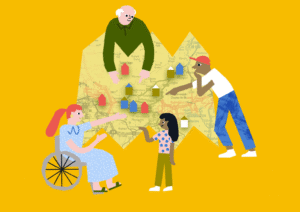
- Visual Icebreakers: We used printed photos of parks, street furniture, shaded nooks, and bright murals from other cities. This sparked a dialogue: “What do you like? What won’t work here?”
- Adolescent-Led Walkalongs: With prior consent, a few young girls and boys guided us through their daily routes like school, tuition, shops. Seeing the space through their eyes revealed gaps that maps never show.
- Listening Without Extracting: We made sure not to treat interactions as data-gathering. Sometimes we’d visit without any agenda. Familiarity, not form-filling, was the goal.
Shifts I Noticed
By the end of the month, small shifts were visible:
- A group of girls in Sodala asked if they could help conduct a safety walk.
- A local shopkeeper volunteered to host our next community discussion.
- In Bhumiya Basti, parents who were wary of “intervention” began asking when the next session would be.
These may not seem like design milestones, but they are signs of ownership taking root.
Reflections
I’m learning that community engagement is not a step in the project;it is the project. Trust-building is slow, non-linear, and deeply contextual. It doesn’t show up in monitoring reports, but it determines whether the work lives or fades after implementation.
Designs can be replicated. Relationships cannot.
As we prepare for co-design sessions next month, I’m carrying forward not just sketches, but stories, and the responsibility they bring.