Indian cities have reached a tipping point. For two decades, our focus was on digitizing services, such as getting permits and taxes online. Today, data is no longer just a digital trail; it is the vital infrastructure that makes service delivery possible.
As we shift from fragmented apps to unified platforms, the stakes have moved. The critical question is no longer whether we have data, but how we govern it to build, rather than erode, public trust. This year, that question feels deeply personal. For a city administrator, good governance is a real-time dashboard for fund flows. But for a resident, it is experienced more intimately: it is the difference between a transparent explanation for a rejected application or a frustrating "invalid/unauthorized transaction" that halts a family’s water connection or a street vendor’s permit.
Technically, we are seeing deeper integrations, linking property taxes to building permissions or connecting grievance portals directly to departmental workflows. But the "real" work isn't just in the code. It is the painstaking, often neglected task of deciding who is accountable for a specific variable and under what conditions that data can be shared.
We must reconcile the institutional need for compliance with the citizen’s expectation of dignity.
While frameworks like MoHUA’s Data Smart Cities provide a map, they must now evolve for an AI- enabled world.
This is where U-CAN finds its purpose. As a collective, we can bridge the gap between high-level policy and field realities. By documenting responsible practices and fostering dialogue between technologists and communities, we can ensure that urban data doesn't just build "smarter" systems, it builds a more trustworthy relationship between the city and its people.
Gautham Ravichander
Director – Policy & Advocacy, eGov Foundation
Member Highlights
What the SUJOG impact data reveals about digital municipal services
The November 2025 SUJOG Impact Performance Report by eGov Foundation and 60 Decibels assesses how digital municipal services delivered through Sustainable Urban Services in a Jiffy (SUJOG), are functioning across urban Odisha. Drawing on 317 interviews (104 employees and 213 citizens) across municipalities, municipal corporations, and Notified Area Councils, the study provides a grounded view of implementation.
Among employees, 7 in 10 report improved efficiency and reduced documentation time. However, 6 in 10 continue to face challenges, particularly server downtime, connectivity issues, and unresolved technical problems. Satisfaction levels drop sharply where these persist. On the citizen side, awareness of digital services is growing, yet most respondents still rely on assisted or offline channels. Delays in grievance resolution and uneven digital comfort remain recurring concerns.
The report recommends three areas of focus: identifying and addressing bottlenecks in issue resolution, especially connectivity-related disruptions; examining differences in experience across ULB types to better tailor support; and strengthening citizen enablement to bridge digital skill gaps.
Together, the findings suggest that sustaining digital governance requires attention not only to platform expansion, but to reliability, frontline workflows, and continued investment in institutional and citizen capacity.
Examining how digitalisation is reshaping urban governance
In 2023, Khaliq Parkar and Uttara Purandare at the Centre for Policy Research (CPR) analysed how digitalisation has unfolded across Indian cities under the Smart Cities Mission and its influence on the National Urban Digital Mission. The paper maps the wider ecosystem surrounding city data systems, from Integrated Command and Control Centres and interoperable platforms such as IUDX to the introduction of City Data Officers, national data standards, and performance-linked assessment frameworks.
The analysis shows that digital reforms have extended beyond technology deployment; they have introduced new reporting structures, standardised metrics, and institutional roles that shape how urban performance is defined and compared. In doing so, digitalisation is influencing not only how cities collect data, but how priorities are set and accountability is structured.
For members working at the intersection of data and governance, the paper offers a clearer view of the institutional architecture now shaping urban decision-making.
Opening transport data for climate-resilient cities
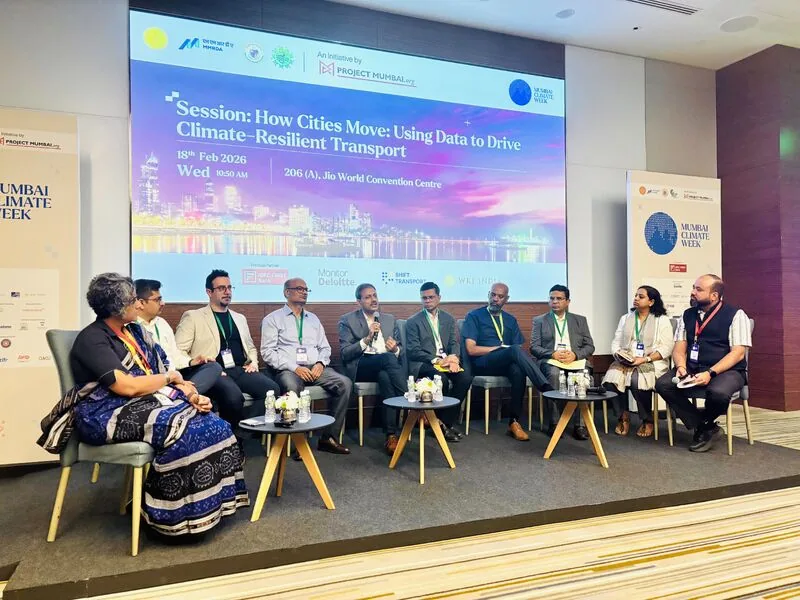
At Mumbai Climate Week 2026, WRI India convened a session under the SHIFT Transport Coalition on “Data to Drive Climate-Resilient Transport.” The discussion explored how mobility data can move beyond isolated datasets to support integrated, climate-aligned planning.
Speakers highlighted that transport data often remains fragmented across agencies, limiting its usefulness for planning, innovation, and public accountability. Standardized, shareable formats and governance mechanisms, including open data requirements in procurement, were seen as critical to breaking these silos. At the same time, analytics must reflect lived realities: walkability, safety perceptions, gendered travel patterns, and income disparities all shape how people move in ways that raw traffic counts cannot capture.
The session also emphasized that data should guide future-focused decisions, from forecasting and multimodal planning to lifecycle management, rather than only analyzing past trends.
Ultimately, transport was emphasized as the backbone of urban life, connecting people to work, services, and opportunities when planning is both integrated and inclusive.
Lived realities of rural water supply in Bihar
Through the support of Samaaj Data, a Reap Benefit initiative, Gram Chetna Andolan is using local data to improve governance and understand rural water supply in Bihar. The community- based organisation conducted a household-level audit covering 3,548 households to examine how the Har Ghar Nal Ka Jal scheme is performing in practice.
The findings reveal a clear gap between infrastructure and service delivery: while around 67% of households reported having a tap connection, only about 34% said water consistently reached their homes and met daily needs. Residents described irregular supply, short durations, and insufficient quantities, showing that functional connections alone do not guarantee reliable access.
This work highlights the value of community-led, hyper-local data in making last-mile realities visible and informing more responsive approaches to service delivery, particularly as water stress increases.
U-CAN’s Request for Collaboration (RFC) is emerging as more than a coordination mechanism. It is becoming a live test of how collectives translate shared intent into joint action. As member organizations respond to and shape the RFC together, the process is revealing what collaboration demands in practice, not just in principle.
One early insight is that collectives gain traction when collaboration is anchored in a clearly defined problem, rather than a broad call to “work together.” The RFC has prompted organizations to locate their strengths in relation to others, whether in community engagement, technical expertise, policy navigation, or knowledge building, allowing complementary roles to emerge organically. This has reduced duplication while strengthening the overall response.
The RFC is also functioning as an experiment in enabling coordination without over-structuring it.
Light-touch processes, including shared check-ins, open documentation, and evolving scopes of work, are helping maintain alignment while preserving organizational autonomy. These practices are beginning to signal what a repeatable collaboration architecture within U-CAN could look like.
At the same time, the RFC is surfacing important questions for the collective’s future. How can collaboration remain responsive to local contexts while operating within shared timelines? What forms of shared learning can capture collective value without flattening diverse contributions? And how can the process remain accessible to smaller, locally rooted organizations that may lack the bandwidth to engage in resource-intensive collaboration?
As this work evolves, the RFC stands not as a finished model but as an ongoing experiment in collective practice. The learnings emerging from it will shape how U-CAN designs future collaborations, reinforcing that collective action is not automatic, but built through deliberate structures, trust, and continuous adaptation.
Opportunities
WRI India - Consultant, MobiliseHER
Analyse gender-disaggregated household mobility data across Ahmedabad, Bengaluru, and Kochi to support inclusive urban transport planning.
Conduct literature reviews, undertake quantitative and spatial analysis, and draft a Working Paper translating findings for policymakers and urban mobility stakeholders.
Requires Master’s in Gender Studies, Urban Planning, Public Policy, or related field, with 7–8 years’ experience in research writing, data analysis, and knowledge product development; GIS skills preferred.
Based in Ahmedabad, Ranchi, or home-based Lead policy engagement and government liaison on urban development, housing, WASH, energy, and livelihoods for women and girls.
Requires a Master’s in Public Policy, Economics, or related field, with 5+ years’ experience.
We use only essential cookies to make this site work. With your consent we would also measure anonymous usage to improve it. You can change this at any time from “Manage cookies” in the footer.