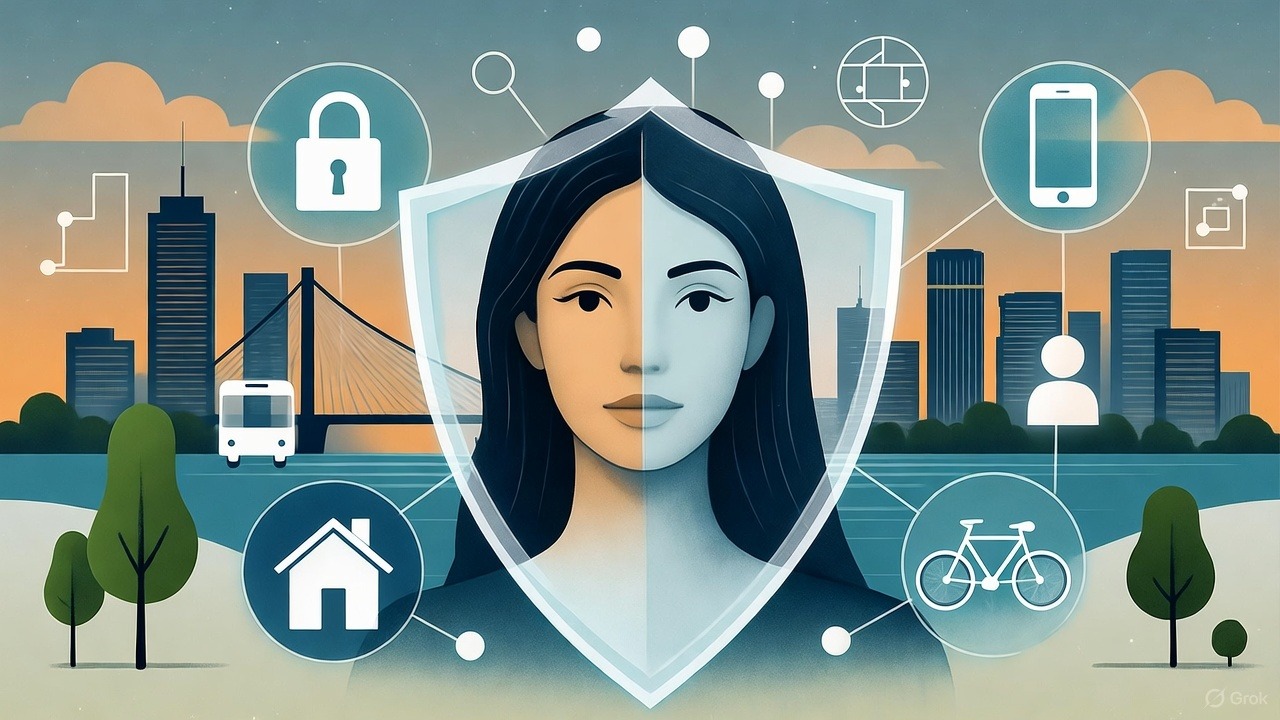
“Smart cities promise efficiency, but can they also promise safety? For women, technology could be both a shield and a barrier.”
Urban planning and policy debates in India increasingly talk about “smart cities.” The promise is simple: technology can make our cities more efficient, more responsive, and more connected. But for women navigating public spaces, efficiency alone is not enough. The question is whether technology can also make cities safer.
Mobile applications have been one of the most visible attempts to address this challenge. The Delhi Police’s Himmat Plus app allows women to send an SOS alert directly to the police control room, streaming their location and even audio or video in real time. Yet, despite the innovation, adoption has remained limited. By 2022, in a city of nearly 20 million people, the app had only about 40 per cent registered users compared to the population it aimed to serve (Hindustan Times).
Another example is the Raksha App, launched by the Ministry of Women and Child Development. With a single click, it alerts emergency contacts and the nearest police station, while continuously sharing the woman’s location. While such tools expand women’s options in distress, their reach is still modest. Awareness campaigns, trust in institutions, and cultural acceptance play a major role in whether these apps are actually used. Apps like Safetipin have gone further in linking technology to urban planning, but adoption and consistent usage remain key challenges.
Beyond apps, cities are also deploying surveillance technologies such as CCTV networks, GIS-based mapping, and AI-driven predictive policing to identify harassment hotspots and allocate police resources more effectively. These tools carry promise, but also raise concerns. Surveillance is often framed as protection, yet it can also infringe on privacy, create new forms of social control, or disproportionately target marginalised groups. Safety for women cannot come at the cost of freedom and trust.
There is also the problem of access. According to the GSMA Mobile Gender Gap Report 2023, only 29 per cent of women in India own a smartphone, compared to 48 per cent of men (GSMA). Many women still rely on shared or borrowed devices, which limits their ability to use safety apps consistently. Affordability, digital literacy, and social norms around phone use all contribute to this divide (GSMA). This means that the very women who are most vulnerable to unsafe urban conditions are often excluded from the benefits of digital solutions.
For technology to genuinely empower women, it must be designed inclusively. This means ensuring apps are multilingual, lightweight, and usable even with low bandwidth. Privacy protections must be built in to prevent misuse of sensitive data such as GPS locations or videos. Most importantly, digital tools should complement, not replace, community-based safety measures such as women’s safety walks, participatory audits, and neighbourhood planning forums.
Smart cities cannot outsource women’s safety to algorithms. Technology is powerful, but it works best when anchored in lived realities and backed by political will. The promise lies not just in apps and sensors but in how they connect to women’s everyday needs and experiences. Unless access gaps and privacy concerns are addressed, technology risks creating yet another layer of exclusion.
For women in Gurgaon and across India, safety is not just about being protected by smart systems. It is about being heard, represented, and included in how those systems are built. When technology is democratised and grounded in community needs, it does more than make cities smart. It makes them just.