Harnessing Rainwater to Secure India’s Urban Future: Industry’s Role and a Calculator’s Impact
As I stand on my balcony in Gurugram, watching the monsoon rains drench the city yet leave water shortages unresolved, I reflect on the past months that I’ve spent grappling with India’s water security challenges. With a background in sustainable urban planning, I’ve been working on a project to develop a simple, accessible Rainwater Harvesting Calculator, a tool I believe can transform water governance in Haryana. Water mismanagement and rapid groundwater depletion—17% of India’s blocks are overexploited—threaten urban ecosystems and individual lives here. For me, a woman navigating this crisis, the stakes feel deeply personal. Industry, a key stakeholder, can amplify this tool’s impact, making rainwater harvesting the cornerstone of urban resilience.
India’s water crisis is acute, with only 4% of global freshwater for 18% of the world’s population, the region faces dwindling supplies. Groundwater levels in Haryana drop 1.5 mts annually in some areas, and by 2030, 40% of India’s population, including parts of this state, may lack drinking water access. Ecologically, this degrades local rivers and aquifers, disrupting biodiversity and the region’s economic backbone—industry and agriculture. For individuals, it’s a daily struggle: rationing water, battling contamination-related illnesses. I’ve noticed this burden impacting women disproportionately —queuing for tankers eats into their time. Studies also show that women face 30% higher health risks from waterborne diseases and heat stress, widening gender gaps. Working on this calculator, I’ve grappled with frustration and hope, knowing its impact could free women for other pursuits.
Simplifying Decision-Making
The Rainwater Harvesting Calculator is thus a vital solution. Designed for ease of use, it lets industries, businesses, and households input local rainfall and surface data to estimate harvestable water, guiding infrastructure choices. Industry’s relevance is critical—sectors like manufacturing and IT in Gurugram consume 10% of India’s water, often in stressed zones. By using the calculator, companies can reduce groundwater reliance and recharge aquifers. For instance, Haryana firms adopting rainwater systems have cut water demand by up to 30%, with potential to triple depletion recovery if scaled.
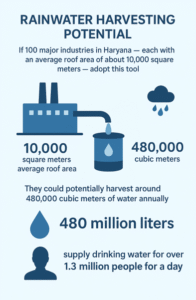
To illustrate the scale, if 100 major industries in Haryana—each with an average roof area of about 10,000 square meters—adopt this tool, they could potentially harvest around 480,000 cubic meters of water annually, based on the state’s average rainfall of 600 mm and a runoff coefficient of 0.8 for rooftops. This equates to roughly 480 million liters, enough to supply potable water for over 1.3 million people for a day, assuming average daily needs.
The tool thus fosters ecosystems of shared governance, linking industries with communities to prioritize water. Testing it with local businesses has shown me its potential to drive change. By centering rainwater harvesting with this tool, we can secure Gurugram and Haryana’s ecosystems and address the annual civic menace that we witness.