
Quantifying the Invisible: How a Simple Tool is Changing Rainwater Harvesting in Cities
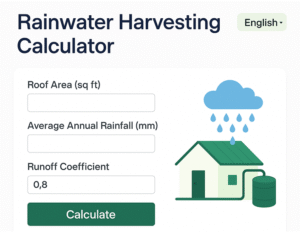
Over the last year, I’ve been closely involved in something deceptively simple but potentially transformative – a Rainwater Harvesting (RWH) Calculator. On paper, it’s just a digital tool that estimates how much rainwater you can harvest based on your roof size and average rainfall. But in practice, it is helping us answer a fundamental challenge in urban water governance: how do you make people see the value of water they can’t yet touch?
When You Can’t See the Problem, You Don’t Act
In most Indian cities, including Gurugram, where I work, water scarcity is not just a supply issue. It’s a visibility issue. People do not feel the urgency to act because they cannot visualise the impact of their inaction. Despite building bylaws mandating RWH structures, during our enforcement drives, we repeatedly encountered puzzled homeowners, unaware of what “a functional recharge pit” even looks like, let alone why they should invest in one.
There’s also a persistent gendered aspect to this. I’ve often observed how women in households are deeply concerned about the quality and availability of water but have limited access to technical knowledge or decision-making power regarding home infrastructure. When I first explained the idea of harvesting rainwater using our calculator to a group of homemakers in a low-rise apartment colony, one of them told me, “At least now I can show my husband what’s possible, with actual numbers.”
Turning Roofs into Reservoirs, One Click at a Time
This was the intent behind developing the RWH Calculator. A tool that moves rainwater harvesting from a vague environmental idea to a quantifiable decision. Input your rooftop size and locality, and the tool calculates your annual harvest potential in litres. For instance, a 1,000 sq ft roof in Gurugram can harvest up to 3 lakh litres of water per year, equivalent to the drinking needs of a family of five for over 7 years (based on WHO estimates).
This simplicity matters. It helps end users make informed decisions, influences fence sitters who are unsure about investing in recharge pits, and even enables contractors and masons to advise homeowners more confidently. The principle behind it is clear: what gets measured, gets done.
Designing for Scale: How a Small Tool Unlocks Big Conversations
Our RWH Calculator is designed to be open-access, mobile-friendly, and multilingual. It’s being integrated into awareness campaigns, planning dashboards, and even shared via WhatsApp groups of ward councillors and RWAs. I’ve been particularly mindful of making it visual and intuitive, because as a woman in a male-dominated water infrastructure space, I’ve learned that accessibility is not just technical, it’s emotional.
The calculator also serves another critical function: spurring an ecosystem of implementation. When contractors, junior engineers, and urban planners see how easy it is to plug in a few numbers and generate an estimate, it reduces friction in uptake. What was once an abstract discussion becomes a real, measurable, and actionable idea.
Looking Ahead
This journey has taught me that tools don’t just solve problems; they shift perceptions. We’re no longer talking about rainwater harvesting as a compliance issue; we’re showing it as an opportunity. And in a city where most residents are unaware they can harvest lakhs of litres from their own roofs, this tool is already beginning to change the narrative.
For me, the satisfaction lies in creating something that not only makes my work easier but empowers others, especially women, to engage with water decisions on their own terms. The RWH Calculator is a small step, but in the right direction: one that moves from abstraction to action, one drop, and one click at a time.