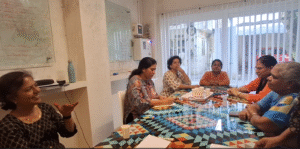
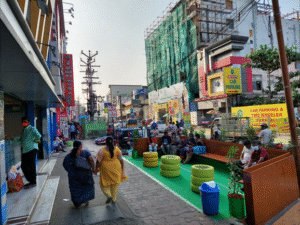
I remember the first community engagement workshop I helped organise as an urban designer twelve years ago for a street design project in Bangalore. We had printed the design vision in a community hall for comments from the public as part of a stakeholder workshop. The community attendees were mostly senior citizens, as it was a weekday and they appeared to have come for one reason alone: they were all angry. They started complaining about dysfunctional water connections, garbage on the streets, and raw sewage outside their homes. Unfortunately, we were not able to engage with them to discuss the design, because we needed to first surmount their sense of alienation before co-creating solutions.
Urban policymakers often gloss over the social processes that are essential preconditions for more engaged citizens, leading to situations like those described above. A lack of attention to the processes that build social cohesion which in turn leads to a sense of agency means that many well-intentioned efforts to promote local participatory planning in India fall short of their objectives. And, as detailed in my previous blog, neighbourhoods are the spatial scale where a sense of community and cohesion can best be nurtured. In fact, research studies strongly correlate neighbourhoods and well-being. A study from China shows that rates of depression for seniors were inversely correlated to the social cohesion in their neighbourhoods, even more than the socio-economic status of the neighbourhods they lived in.[1]
There is a close relationship between civic engagement and democratic participation. This is true of forms of civic engagement that have nothing to do with the economy or the polity, such as cultural associations and organisations centred around leisure activities like bowling leagues. [2] It stands to reason that we learn to be better citizens who can participate fully in democratic processes if we grow up in neighbourhoods that are cohesive.
Although there are many definitions of social cohesion, some of the common themes that define cohesive neighbourhoods and communities are:
- Neighbourhoods that have positive civic norms and values (eg. people don’t litter)
- Neighbourhoods with mechanisms of non-coercive social order and social control (eg. people don’t litter because they care what their neighbours think of them, not only because they are afraid of a fine)
- Neighbourhoods where people demonstrate social solidarity across classes ( Eg. People help out their neighbours when they are in a pickle even if they aren’t related to them or otherwise “important” in terms of wealth or social status because of strong norms of reciprocity cutting across social groups)
- Neighbourhoods with strong social networks and social capital (Eg. they can be assured that if they needed help, they would get it from their community)
- Neighbourhoods where residents share a sense of belonging and place identity (they identify as being “Mylaporean” i.e. from Mylapore,, for example).[3]
How do heritage and culture fit into this framework? People invest meaning in heritage and historic precincts, which to them are representative of culture, values and inheritance. Memory and emotional engagement in heritage can be important tools to engender a “sense of place” that can lead to an improved sense of well-being. [4] For example, when I interview people about growing up in the historic neighbourhood of Mylapore in Chennai as part of the Pelathope community archive oral history project, their memories of certain landmarks and places and their emotional attachment becomes immediately evident through their body language and tone. This is especially true when interviewing senior citizens, who are often lonely, and in many cases, have lost their friends and partners and have no one with whom they can reminisce about shared experiences and memories. After conducting an oral history interview, I’ve observed many participants seem happier and more energetic, even if this emotion is only temporary.
Culture and heritage are essential ingredients of engendering place attachment, which in turn leverages a sense of cohesion to create a sense of identity and belonging. Currently, there is a gap in the policy framework on how to better integrate culture, heritage and cohesion into development planning at the neighbourhood scale. Through my work on PULL, I am endeavouring to add to the knowledge base on how we can address this gap through urban action research.
[1] Wang, Donggen, Fanzhi Chen, and Roger C.K. Chan. “The Effects of Neighbourhood Characteristics on Urban Residents’ Sense of Community: Evidence from Shanghai.” Urban Studies 53, no. 13 (2016): 2725–2742. https://doi.org/10.1177/0042098015613238 and Miao, Bo, Donggen Wang, and Roger C.K. Chan. “Place Attachment and Sense of Community: Evidence from Shanghai, China.” Habitat International 82 (2018): 112–121. https://doi.org/10.1016/j.habitatint.2018.10.002.
[2] Robert D. Putnam, Making Democracy Work: Civic Traditions in Modern Italy (Princeton, NJ: Princeton University Press, 1993), 213.
[3] ¹ Ade Kearns and Ray Forrest, “Social Cohesion and Multilevel Urban Governance,” Urban Studies 37, no. 5–6 (May 2000): 996–1000, https://doi.org/10.1080/00420980050011208.
[4] “How do people react to and make use of heritage sites?” (Bagnall, 1997)