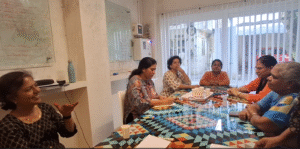
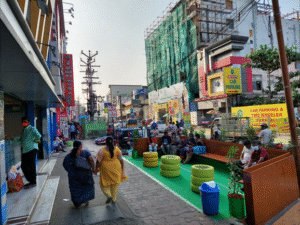
I visited the historic precincts of Shahjahanabad (Delhi), Chowk (Lucknow), Mylapore (Chennai) and Panchvati in Nashik recently on work expeditions. All of these places have borne witness to important events in our country’s history and hold memory and meaning for many, but they now lie neglected. Narrow lanes where children used to play under the watchful eyes of their parents and grandparents are now blocked with two-wheelers and cars. Charming historic facades lie dilapidated and sit alongside newer multi-storey apartment blocks on narrow plots on streets that were never designed for that level of density. Open-air markets have disappeared, to be replaced by supermarkets.
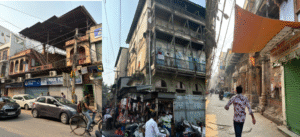
An old building converted into shops and warehouses with extensions in Shahjahanabad, Delhi
Historic precincts in urban cores are often home to artisans and cultural industries in addition to built heritage, and are thus perfectly poised in terms of scale and scope to offer a window into a shared past and heritage that could offer insights for a low-carbon, sustainable future. They could become assets to cities- they already have many of the characteristics that are necessary for strong, cohesive communities, such as social bonds and neighbourly interactions, cultural institutions, and intangible heritage -but are currently neglected in policy frameworks outside of tourism-driven contexts like the Jaipur walled city.
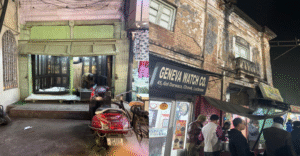
Street view in Chowk, Lucknow A perfume shop in Chowk, Lucknow
In order to address the challenge of making historic precincts future-ready, I started reading about successful case studies from the sustainability transitions literature that highlight how complex adaptive systems (like historic precincts and urban neighbourhoods) could transition towards sustainable pathways with strategic inputs.[1] When defining the problem to be solved, I realised, it was important to define a long-term horizon of at least 20+ years, and to create spaces for innovation that could act as catalysts for change. The key to ensuring that spaces for innovation could catalyse positive change in the larger landscape was to design a process that was embedded in the context and focused on social learning.
In my previous blogs, I outlined the need for bottom-up participatory planning in Indian cities, why the neighbourhood scale is important for better planning outcomes, and why a focus on culture and cohesion could foster greater engagement by citizens. Towards that end, there are three relevant approaches I have employed as a starting point to tackle the “wicked” institutional problem of historic precinct and neighbourhood planning:
- Asset-Based Community Development (ABCD) is a strategy for sustainable community-driven development that focuses on identifying and mobilizing the existing strengths, resources, and capacities (assets) of a community — rather than concentrating primarily on its problems, needs, or deficiencies (needs-based approach).
Key takeaway: Shift perspective to thinking that maybe the problem isn’t always a “problem” but an underutilised asset (eg. heritage)
- The term Historic Urban Landscape (HUL) refers to a holistic approach to understanding, managing, and safeguarding historic cities and urban areas — one that recognizes not just individual monuments or buildings, but the entire urban context as a dynamic, living system shaped by cultural, natural, social, and economic forces over time.[2] The framework is dynamic (integrating change), integrative (across sectors), people-centered (participatory), and focused on sustainable development alongside highlighting tangible and intangible heritage. Some examples of a HUL approach being deployed in India are in Mehrauli, Delhi as well as Varanasi.
Key takeaway: Thinking of heritage as a series of processes and interactions essential to how neighbourhoods function, not as a nice-to-have layer in urban planning frameworks
- Institutionalising an urban action research approach through the establishment of an urban living lab (ULL).[3] ULLs are experimental arenas within real-life urban settings where researchers, policymakers, businesses, and citizens co-design and test innovative solutions to urban problems (e.g., sustainability, mobility, housing, culture). The ULL concept gained traction in Europe through smart city and sustainability initiatives (e.g., European Network of Living Labs, JPI Urban Europe). ULLs emphasize experimentation, iteration, and learning by doing, often using pilot projects and prototypes, in order to foster long-term sustainable transitions while fostering innovation. Examples:
- BlueCity Lab (BCL), Rotterdam; Focus: Platform for circular economy
- Concept House Village Lab, Rotterdam; Focus: Test bed for sustainable building technologies
- People’s urban living lab by Transitions Research; Focus: Testing and co-creating pilot solutions with stakeholders for building climate resilience in Indian cities
Key takeaway: Start small and local by creating a locally embedded niche for experimentation that can be scaled up upon demonstrating proof of concept.
Historic precincts are not just relics of the past — they are living, breathing parts of our cities that hold the key to more resilient, connected, and sustainable urban futures. By shifting our perspective from seeing them as “problems” to recognising them as underutilised assets, we open up space for innovation grounded in local identity and community strength. These three approaches taken together offer radical new ways of thinking about the problem or opportunity of creating participatory and adaptive planning processes that are not only context-sensitive but also capable of driving long-term change. If we are to build cities that honour memory while embracing transformation, then historic precincts must be part of the conversation — not as passive backdrops, but as active agents in shaping inclusive, low-carbon urban futures.
[1] Frank W. Geels, “Technological Transitions as Evolutionary Reconfiguration Processes: A Multi-Level Perspective and a Case Study,” Research Policy 31, no. 8–9 (2002): 1257–1274. A socio-technical system refers to an interconnected system made up of both social elements (people, institutions, norms, practices) and technical elements (technologies, infrastructures, tools) that work together to produce particular functions or services in society. In other words, it describes how technology and society are deeply intertwined, co-evolving over time. Neither technology nor social organization operates in isolation — they shape and depend on each other.
[2] UNESCO, Recommendation on the Historic Urban Landscape (Paris: UNESCO, 2011)
[3] Kurt Lewin, “Action Research and Minority Problems,” Journal of Social Issues 2, no. 4 (1946): 34–46.