
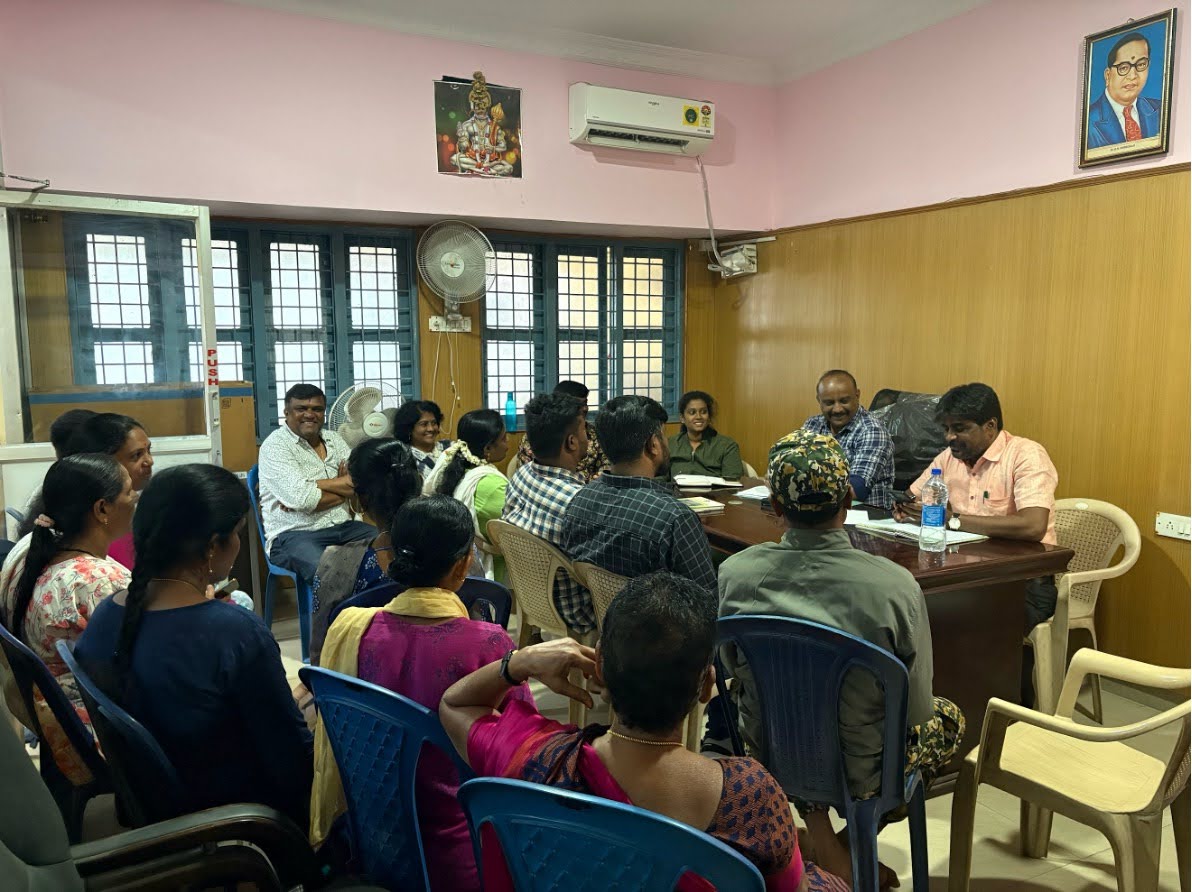
A Ward Committee Meeting in Hoodi Ward, Bengaluru
In the previous blogs, I explored how laws, institutions, and collaborations create the Enabling Ecosystem (the first category of the framework) for citizen participation.
The next category in the framework is the Design of Platforms, where I turn to the question of who constitutes these platforms, how diverse they are, and how deeply they engage with citizens across levels of governance. It also encapsulates the operational aspect of the platform for their effective functioning, through conduct and quality of their meetings.
Diverse Composition with Socio-economic representation
A truly representative Ward Committee or Area Sabha is not just a meeting of officials and councillors; it is a microcosm of the community it represents.
Across several cities I visited for the study like Trivandrum, Bhubaneshwar, Bhuj, Siliguri, and Giridih; platforms are consciously designed to bring together a mix of stakeholders: elected councillors, executive officers, representatives of civil society organisations (CSOs) and NGOs, residents’ groups such as RWAs, and community networks like Self-Help Groups (SHGs) and Neighbourhood Groups (NHGs). The inclusion of subject matter experts, youth, women, senior citizens, and marginalized groups helps anchor discussions in both technical understanding and lived experience.
Some states and cities have institutionalised this diversity through mandatory reservations. Kerala, Bengaluru, Mangaluru, Bhuj, Delwara, Siliguri, reserve 40–50% of Ward Committee seats for women, ensuring that women’s voices move from the margins to the centre of governance. Bhuj sets aside 20% participation for senior citizens, while Odisha and Bhuj also reserve seats for youth, an important step toward intergenerational inclusion. Kerala and Delwara ensure representation of marginalised groups such as Scheduled Castes and Scheduled Tribes.
Cities have also shown creativity in diversifying inclusion. Siliguri includes subject matter experts within its Ward Committees, enriching discussions with technical and sectoral knowledge. Bhuj, on the other hand, invites retired government officers to participate, bridging institutional experience with community aspirations.
Kerala, Odisha, Bhuj, West Bengal, and Giridih have participation of sub-ward level groups like SHGs, NHGs, and RWAs, ensuring the committee structure mirrors the social networks that already exist in the community. This composition is what transforms participatory platforms from bureaucratic units into spaces of lived democracy.
Depth of Participation: Bringing Governance Closer to People
While diversity ensures who participates, the depth of participation determines how they engage. Many cities have developed multi-layered participatory systems, where citizens can engage at multiple scales of governance rather than being confined to a single ward-level platform.
Kerala sets a strong example. Under the Kerala Municipality Act, 1994, Ward Committees function alongside Ward Sabhas, thematic working groups under the People’s Planning Campaign, and community-based organisations such as Community Development Societies (CDS), Area Development Societies (ADS), and Neighbourhood Groups (NHGs) under the Kudumbashree Mission. Together, they work in convergence and provide avenues of participation from neighbourhoods to wards to city level.
Under the Mizoram Ward Committee and Local Council Rules (2010), cities of Aizawl and Lunglei follow a similar model, where along with Ward Committees, Local Councils operate at a sub-ward level.
In Delwara (Rajasthan), a network of Mohalla Committees, Aam Sabhas, and Karyakarnika at ward and sub-ward levels connects directly with the Nagar Vikas Manch at the city scale. Sectoral committees under these forums, such as those on waste management and heritage conservation, allow citizens to engage in focused, issue-specific decision-making.
Siliguri’s Ward Committees also include sub-committees on health, education, water, and sanitation, enabling deeper deliberation and problem-solving.
These multi-layered platforms decentralise governance and transform participation from an occasional meeting to an ongoing process, where citizens don’t just respond to governance, they help shape it.
For participation to be a continuous practice, it’s important for the platforms to operate in a structured manner. In the next blog, I will explore how the quality and conduct of meetings determine whether participation truly translates into shared governance.


